First published by New Epoch on 1 September, 2024
Reposted by The Epoch Times on 30 September 2024
by Bonie Chen
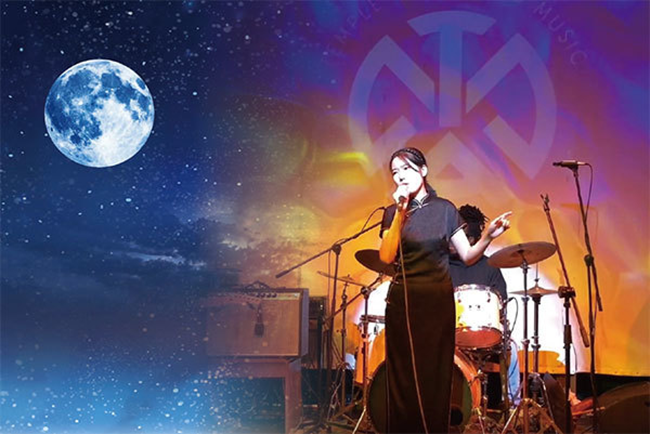
Article · Bonie Chen Photo courtesy · Gene
Around the Mid-Autumn Festival in 2023, Gene wore a black cheongsam and appeared at a concert in London. She sang “Prelude to Water Melody” in English, which is the well-known “水調歌頭 (Prelude to Water Melody)” originally sung by Teresa Teng and written by SU Shih, “但願人長久” (Literal translation: May Human Life Be Long).
“How rare, the moon, so round and clear! With a wine cup, I ask of the blue sky” Gene wore a black cheongsam and sang Teresa Teng’s famous song ” Prelude to Water Melody” in English at a concert in London, enabling Western audiences to appreciate SU Shih’s poem “Prelude to Water Melody” which was written more than a thousand years ago. The beautiful moonlight in a mid-autumn festival night, the reflection on the ultimate nature of heaven and human, the yearning for the beloved family, and a mortal’s expectation for the eternal beauty of life.
After receiving a full scholarship from a UK university and completing her master’s degree in translation, Gene became a freelance interpreter and translator in the UK. Since coming to this free country, she has continued her studies, devoted herself to independent academic research in lyrics, film and television subtitle translation and other related fields, and published many papers. At the same time, Gene is keen to participate in charity or live performances, and support universities and other educational bodies as well as local music activities in the UK and beyond. She found that when English/Chinese songs are translated into Chinese/English, people will perceive deeper and wider connotations. It has a great connection with the profound culture that lies in Traditional Chinese characters.
Around the Mid-Autumn Festival in 2023, Gene wore a black cheongsam and appeared at a charity concert in London. She sang “但願人長久” (Literal translation: May Human Life Be Long) in English, originally sung by Teresa Teng and written by SU Shih, which is also the well-known “Prelude to Water Melody”. Even though she sang in fluent English, accompanied by Western instruments, and the audience were all Westerners, through just over three minutes of singing, Gene recreated and conveyed what SU Shih expressed on that full-moon night more than one thousand years ago. The beautiful moonlight in his eyes, his thoughts about the nature of heaven and human, his beloved family, and a mortal’s expectation for the eternal beauty of life. This is so far the most faithful song translation of English lyrics for SU Shih’s original poem.
The singing performance and recreation of English lyrics were part of Gene’s research. Gene’s performance that day received countless applause. She said: “I am very surprised and happy. It means that my work can be truly ‘read’ by people with other cultural backgrounds, and they could understand the profound connotation of this poem.”
In April this year, Gene gave a conference presentation in the United States. Her paper combining translation and music studies have won praise and encouragement from Eastern and Western scholars and professors. Professor Posen Liao from Graduate Institute of Translation and Interpretation at National Taiwan Normal University gave her a comment: “The English song you re-translated and your singing performance are so amazing, which is an ample demonstration of your talent for translation and music. Hope you can make the best of your talents into the good use in the future.” Mohammed Salah Uddin, a seasoned professional interpreter and translator in the UK and a certified full member of the Chartered Institute of Linguists (CIOL), said: “Gene has a powerful and melodious voice. The performance was impressive. She is doing a great job making ancient Chinese poems and songs accessible to the world.”
Later after the conference, she also performed this English song “Prelude to Water Melody” at a music event in New York, U.S. The feedback surprised Gene: “The comment from one of the musicians impressed me deeply, The lyrics of this song are so beautiful!’ ” Gene’s biggest wish and her childhood dream is to truly convey the beauty of classical Chinese poetry through poetry and song translation, and singing performance.
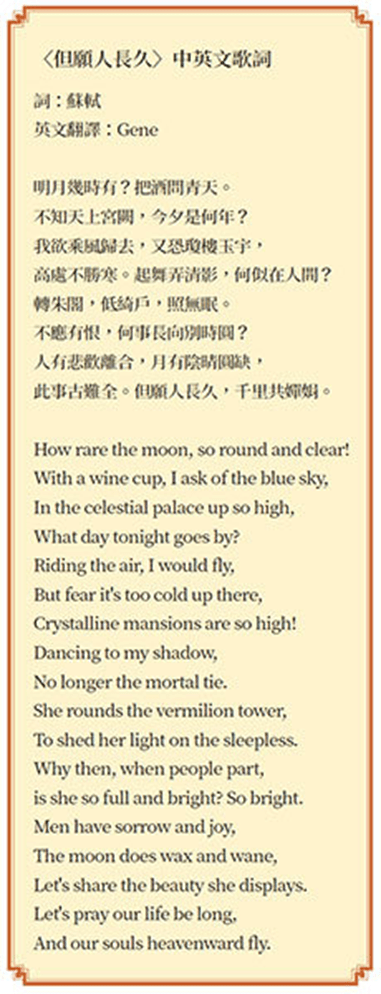
“Prelude to Water Melody (但願人長久)” Chinese-English lyrics
Chinese lyrics
明月幾時有?把酒問青天。不知天上宮闕,今夕是何年?
我欲乘風歸去,又恐瓊樓玉宇,高處不勝寒。起舞弄清影,何似在人間?
轉朱閣,低綺戶,照無眠。
不應有恨,何事長向別時圓?
人有悲歡離合,月有陰晴圓缺,此事古難全。但願人長久,千里共嬋娟。
English lyrics
How rare the moon, so round and clear!
With a wine cup, I ask of the blue sky,
In the celestial palace up so high,
What day tonight goes by?
Riding the air, I would fly,
But fear it’s too cold up there,
Crystalline mansions are so high!
Dancing to my shadow,
No longer the mortal tie.
She rounds the vermilion tower,
To shed her light on the sleepless.
Why then, when people part, is she so full and bright? So bright.
Men have sorrow and joy,
The moon does wax and wane,
Let’s share the beauty she displays.
Let’s pray our life be long,
And our souls heavenward fly.
Learn multiple foreign languages, love music and traditional Chinese characters
Gene said: “I have loved listening to music from Hong Kong and Taiwan since I was a child, and because I like foreign languages, I often listen to songs of various languages, ethnic groups and regions.” She often listens to various cross-cultural songs from morning till night. Cultural and cross-lingual music, from Western classical music to East Asian traditional music, from art songs to folk songs, there are more than 20 types. She often participates in competitions and activities in language and vocal music. She also participated in the final of The 6th Hong Kong International International Music Festival, and won the “Excellent Gold Award in the Pop Music (Voice)” and showed her musical talent at an early stage.
In addition to music, Gene also has an inexplicable enthusiasm for learning foreign languages, such as English and Japanese. She is quiet, taciturn and sincere. She was often mistaken as a Japanese person by her international friends when they first met her. This is partly because she has loved Japanese culture since she was a student and has learned a lot of etiquette from Japanese teachers and friends. She often laments that China is a country of etiquette. Once upon a time it was reduced to this. After junior high school, she came into contact with classmates and teachers from different countries by chance, which made her understand at an early age that foreign language can be a key, opening the door to the culture and history of that country.
Among many cultures and languages, Gene’s favourite is still traditional Chinese culture. As a child, her enthusiasm for “orthodox” Chinese characters (traditional Chinese characters) manifested itself in using simplified Chinese characters only at exams in China and using traditional Chinese characters at all other times including taking notes in class. “When I was a child, I also loved watching the program ‘The Wonderful World of Chinese Characters’ on Taiwan’s NTD Asia Television.” Gene said, “The TV program uses animation to show the mysterious evolution of Traditional Chinese characters, plus interesting historical and cultural stories, which inspired my love for traditional Chinese characters. It was not just about learning the original meanings of Traditional Chinese characters, but it also helped me learn how to conduct myself and become a good person.” In order to learn more traditional Chinese language knowledge and conventions, Gene often communicated with Taiwanese friends, read Taiwan’s Traditional Chinese books, newspapers and articles, and also spent time in Taiwan, traveling around the island. She said: “I was really fortunate to travel around Taiwan, which made me feel deeply honoured and have complicated feelings. I found a lot of genuine traditional Chinese culture in Taiwan, which are missing or lost in China today. At the same time, I found it is a shame that people can no longer see these in mainland China. The people here [in Taiwan] are very friendly and still maintain faith and reverence in heaven and earth, and have freedom of speech, belief, and creative arts and culture. This is a true lighthouse for Chinese communities and a beacon of freedom.”

In November 2019, Gene was in Kaohsiung, Taiwan
Music and translation are both a bridge
In 2019, when Gene participated in the Hong Kong International Music Festival competition, the “anti-extradition movement” was in full swing. The competition was full of twists and turns. She also witnessed that many Hong Kong people were not afraid of death and fought for freedom. Previously, Gene had been paying attention to Hong Kong and Taiwan issues, as well as human rights problems in China. In the musical “Les Misérables”, the English song “Do You Hear the People Sing”, which describes the people’s resistance to tyranny, was translated into the Cantonese version “問誰未發聲 (Literal translation: Ask Who Has Not Spoken Up)” in 2014, as well as the Mandarin (Traditional Chinese) version “Do You Hear the People Sing”, sung throughout the streets and alleys in Taiwan. In early 2022, during the lockdown of Shanghai due to covid-19, the Mandarin (mainland China) version of “我愿为自己发声 (BT: I Would Speak for Myself)” also appeared on the internet. In response to different languages, how can lyrics from different cultures and languages be written as a medium to convey the same emotions? These have become study cases for Gene to do research in song translation. She also hopes that through her academic research and singing performances, more people will pay attention to human rights issues in China, Taiwan and Hong Kong, to what is happening in the world, and give a voice for those who want to speak out but are silenced.
Gene’s original intention in translating singable songs is to bridge the gap between Chinese and Western cultures. Therefore, when she translates East Asian songs into singable English songs. She tries her best to faithfully reflect and present the original meaning of the source poems and songs. She also believes that when translating ancient poetry into singable English songs, the translator must be proficient in both translation and music, and deal with the following key points.
1. Differences between Chinese and English languages and Chinese and Western cultures
Chinese is a language of “parataxis” and focuses on the spiritual level. English is a language of “hypotaxis” and emphasises precision and realism. This is related to both Western and Chinese cultures. For example, if a person says, “I went on a business trip last week” in the Chinese context, the listener does not have to continue to ask about the time, place, people and other details of the business trip. However, in the English context, the listener will usually tell details directly. If one talks about it in English like that in Chinese, the other person would ask where you went, what you did, and who you met. Gene said, “It is really a big challenge to visualise the Chinese ‘imagery’ in English so that the English audience can percept the artistic conception of the original Chinese text without losing its ‘mystery’ and leaving some room for people’s imagination and own understanding.”
2. Poeticity
The translated songs must also remain the “poeticity” of the original poem, poetic beauty or poetic nature, a sense of unfinished meaning. For example, in the English version of the song “但願人長久” (Literal translation: May Human Life Be Long), the word “問” in “Ask of the blue sky” is translated as “ask of” instead of “ask”, which further shows its “poeticity”. For another example, “月有陰晴圓缺” is translated into “The moon does wax and wane ” as “wax and wane” is in response to the phrase “悲歡離合” (sorrow and joy).
3. Rhythm
One of the common characteristics of poetry is “rhyme”, that is, the last word of each line of lyrics must be in rhyme. For example, “sky”, “high”, “tie”, and “fly” all end with the sound /ai/.
4. Song writing
The number of syllables in English lyrics must fit in the composition. Lyric translation must not only rhyme, but also ensure that the lyrics and melody can blend into each other. Contemporary people may have different interpretations of ancient poetry, so there are some choices in song translation, for example, “明月幾時有” may mean “When did the bright moon first appear?” It may also mean “How rare the moon is so round and clear”.
5. Musical theory
Song translators and lyricists must have the literacy and perception to appreciate music, knowledge of music theory, and a clear understanding of song structure, rhythm, melody, tune, etc., so that they can ensure the perfect integration and mutual interpretation of the target song lyrics and music when translating singable lyrics in English.
6. The aesthetic value of music
In fact, “The Book of Songs” is a collection of lyrics. Song poetry and Yuan verse are song lyrics as well. Poetry and song have the same origin. However, the poems left in modern times have lost the element of “song” and “singability” is no long considered. Gene said, “Therefore, if classical poetry can be composed and sung, it will fulfil what the ancients called ‘poetry song'(詩歌); Music and poetry will play a positive role in intercultural communication if Chinese classical poetry can be further translated into singable and performable English songs.”
Understanding the profound connotation of Traditional Chinese characters through song translation
Gene, who has studied song translation for a long time, believes that in addition to being proficient in two languages and mastering the professional knowledge and skills of translation and song writing, studying translation also requires an understanding of the cultural differences, ways of thinking, behaviours, and living habits behind the two languages, and even the differences behind the languages. The historical origins are well known. At her paper presentation in London in 2023, she used the scene in “Les Misérables” where a group of prisoners worked hard and the lyrics “Look down” were repeatedly sung while the Chinese translation on the screen had eight different versions of it. These are meanings re not found in the English text:
| Source text | Target text | Back translation |
| Look down, Look down | 低下頭,低下頭 | Look down, look down |
| Look down, Look down | 低下頭,彎著腰 | Look down, bend over |
| Look down, Look down | 要忍氣,要吞聲 | Restrain anger, keep silent |
| Look down, Look down | 垂著頭,喪著氣 | Down in the dumps, despondent |
| Look down, Look down | 莫癡心,別妄想 | Don’t be fooled, don’t be delusional |
A professor asked Gene why there were such changes in Chinese translation, and why she preferred to use traditional Chinese characters in her report, and what were the differences between simplified and traditional Chinese characters. Gene explained that Chinese language has a lot of changes in word usage and avoid repetition. She used the character “聽” (listen) as an example, “When it comes to “listen” in traditional Chinese writing, it originally encompassed the meanings of hearing by ears, seeing by eyes, perception by heart and feeling by mind. Accordingly, people may find many components of this character to understand it. The simplified Chinese character “听” (listen) however, with its mouth (口) on the left and half a kilogram (斤) on the right, seems to provoke people to open their mouths to speak, be calculating and unwilling to make the smallest sacrifice, which is contrary to the original meaning of the character “聽” (listen). Besides, Gene quoted the Qing Dynasty KUNG Tzu-Chen’s “古史鉤沉二” (Literal translation: Ancient History of the Sinking II), the original sentence is “滅人之國,必先去其史” (Literal translation: To eliminate a country, one must first eradicate its history). Inspired by this, she extended the meaning in her own words, “To eliminate history or culture, it starts with eliminating its language(s) and characters.”
Another example given was the traditional Chinese character “聖” (the saint). Gene mentioned that it originally means one ear and one mouth. When writing it, “ear” is written slightly larger and “mouth” is written slightly smaller, which means that the saint should listen more and speak less. Below the character “壬” means that a person bows down humbly. One listens to heaven with his “ears” and preaches to the people with his “mouth”. This is the original meaning of “the saint” in Traditional Chinese. Since the creation of simplified Chinese characters by the Chinese Communist Party (CCP), the simplified has lost a lot of connotations of and connections to the original meanings of the words and characters. The simplified Chinese characters of “聖” is “圣”, which has “again” on top and “earth” on the bottom. It could be interpreted as working on the farm field (the pictogram). The traditional Chinese character “the saint” has entirely lost its original meaning. Gene believes that it would be more accurate to call simplified Chinese characters “Mutilated Chinese characters”.
Afterwards, Associate Professor Dr Danielle D’Hayer said to Gene, “The examples you provided on the differences between simplified Chinese and traditional Chinese were very good and raised a lot of interest! We are so ignorant about your language that it is good to give tangible examples!”

In January 2024, Gene provided interpretation work for a conference in London, England.
Moving towards the road of translation and cultural dissemination
Professor Dr Michael Frishkopf, Director of Graduate Studies, Department of Music, Canadian Centre for Ethnomusicology, commented that “We performed together at the SEM Ochestra’s improvisational concert. I found Gene’s vocal performance to be most sensitive and touching, and an important contribution to intercultural understanding.”
Based on her love for music, foreign languages, and traditional Chinese culture, Gene laid the foundation for combining poetry translation with music, research and performance. Regarding his expectations for future studies, Gene said,
“As I grow up, I have never changed my initial heart: I love music, especially singing, and I like learning foreign languages and understanding the culture and history of different countries and nations. Looking forward to the future, I hope to work with other musicians and translate good Chinese classical poetry into English and produce original English songs so that English-speaking audiences can truly and more easily understand Eastern culture through music. I also hope that one day, everything in mainland China can return to tradition and Chinese people can truly re-examine their own culture and history.” ◇
Original news article in Traditional Chinese:
Paper edition: click here to download it.
Online version: https://www.epochweekly.com/b5/722/29264.htm
Reposted news article in Traditional Chinese:
Online version: https://www.epochtimes.com/b5/24/8/26/n14317942.htm
 Verse & Voice 樂譯心聲
Leave a comment