Watch the English singing performance of this song here
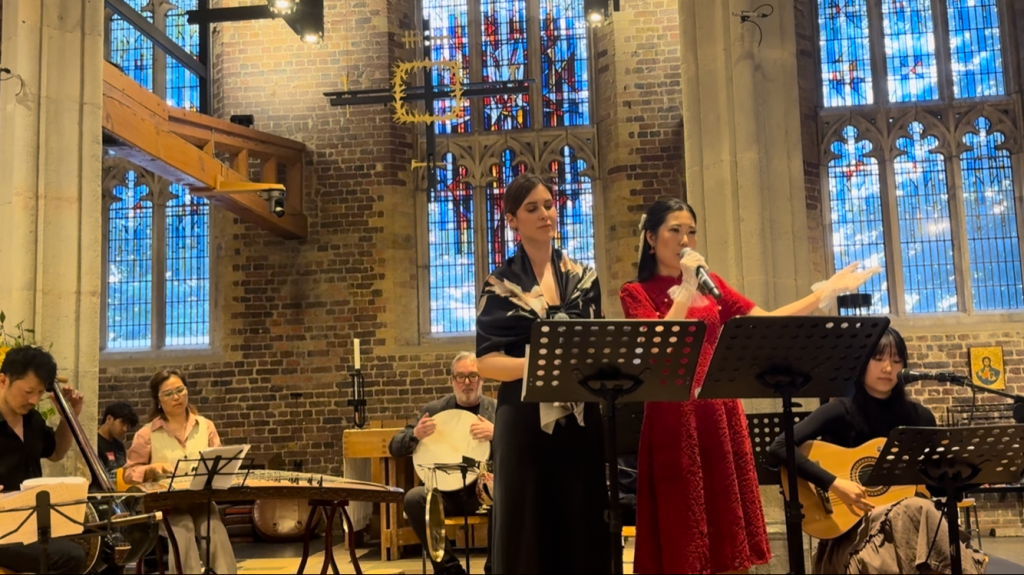
Gene performed at a concert in London, 2025 (Gene, the female singer in a red dress)
Singable Song Lyrics in English
Singer and translator: Gene Hsu
You ask me whether I love you
And if my love is true
All my love is real
Nothing to conceal
The moon represents my heart
You ask me how much I love you
And if my love is true
My love will not change
Not with time or age
The moon represents my heart
Remember how we were
And the memory of your kiss
Sweet love that we shared
I still long for and miss
You ask me how deeply I love you
And if my love is true
Think about it, my dear
Look around where you are
The moon represents my heart
月亮代表我的心 (Chinese song title)
Original Song lyrics in Mandarin (Traditional Chinese)
演唱 Singer: 鄧麗君 Teresa Teng
你問我愛你有多深 我愛你有幾分
我的情也真 我的愛也真 月亮代表我的心
你問我愛你有多深 我愛你有幾分
我的情不移 我的愛不變 月亮代表我的心
輕輕的一個吻 已經打動我的心
深深的一段情 教我思念到如今
你問我愛你有多深 我愛你有幾分
你去想一想 你去看一看 月亮代表我的心
Behind the scenes
The Mandarin song “月亮代表我的心”, lyrics written by SUN I, composed by WENG Ching-hsi, was sung by Teresa Teng between 1970s-80s. Though it is an old song nowadays, the song has been considered one of the most popular Mandarin songs in East Asia in the 20th century and covered by many singers of young generations in the 21st century.
Though there are English translations of Chinese songs, few of them was faithfully translated for a singing purpose. To bridge the gap between song and poetry translation, this English translation is for both the original poem and the Mandarin song, so the English version is singable by English singers and listenable by target audiences.
Translation between Chinese and English can be very difficult, because it is more than translating the source language into the target language, furthermore, it is about translating Western and Chinese cultures. Chinese is a language of “parataxis” while English is a language of “hypotaxis”. Thus, it is not an easy job to translate hidden or paratactic meanings behind the superficial words from Chinese into English. Likewise, it is not easy to use English language to convey those meanings in a hypotactic way.
Translating song lyrics has another layer of difficulty: music. To make sure English lyrics can adapt to the music and align with the song structure is more difficult than translating a poem only. Moreover, there are variants of the same Chinese phrase in English lyrics to avoid repetitions. Some phrases are omitted, the word order is adjusted, and the lines rhyme are ensured to adapt to music.
In conclusion, this translation is a faithful English version of the source song lyrics and presents it to the target audiences in a singable way.
Instagram Post
About the singer and linguist
Gene Hsu, a singer-songwriter-ethnomusicologist and professional interpreter and translator. Gene is engaged in intercultural and interdisciplinary research in music and translation. She has presented her papers at academic and professional conferences around the world. Furthermore, her research draws attention to the historical and intercultural significance of traditional languages, song writing and song translation. Gene hopes her work can contribute to bridge intercultural and language gaps and towards better understanding and world peace.
For more information about Gene’s research and work, please visit https://versevoice.org/research/ and https://versevoice.org/song-translation/
Follow us on IG: versevoiceorg
Follow us on Facebook: Verse & Voice
 Verse & Voice 樂譯心聲
Leave a comment