Review on Gene’s research article “Make It Sing” (excerpt)
Hello Gene,
Congratulations on getting your article published. And it’s a good one, sound and clear. Well, you cover well the different things that people do with songs, and their different purposes – without particularly advocating close translations (as I tend to do). Yet of course I see a cultural value in adaptations: there is certainly a place for localisation, and for the kind of topical adaptation you show in the Cantonese example。 You are right that “song translation” is a variety of activities and outcomes. They include subtitles, surtitles, dubbing, prose versions for reading, and of course singable translations. Your figure of 50-90% is not bad for what I call an adaptation. Now some TTs which are labelled translations seem to me to have transferred more like 60% of the ST’s meaning/content/intent/theme, and cannot be called faithful translations (faithful to the original creators) – and which have labels that are misleading.
Dr. Peter Low
Senior Lecturer Global, Cultural and Language Studies
University of Canterbury, New Zealand
The article mentioned in the comment:
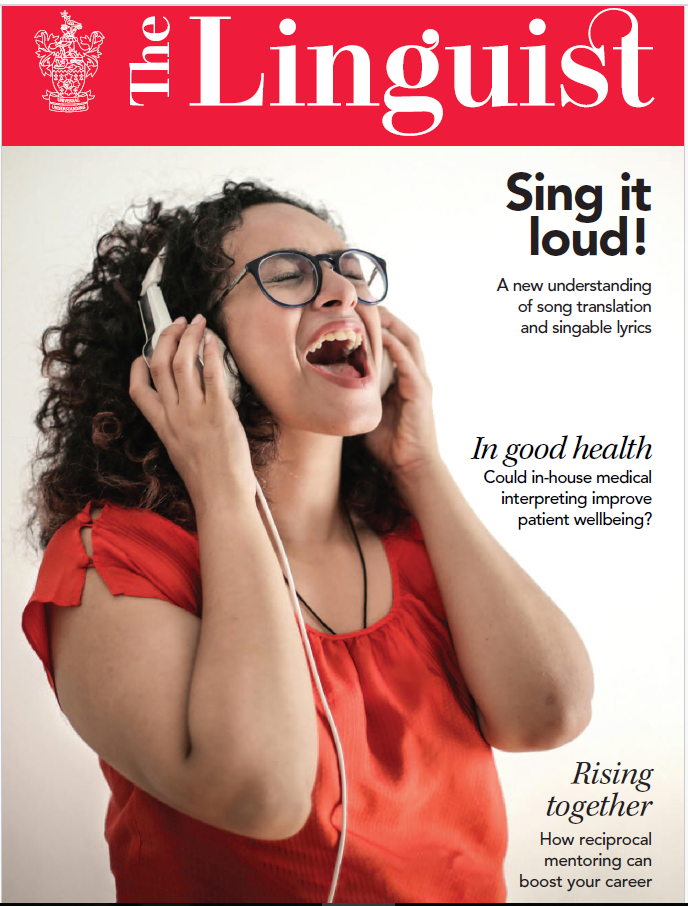
‘Make It Sing?’,Summer Issue, Vol 63, No. 2, The Linguist, CIOL (hardcopy and electronic versions).
The article is on pages 11-13. Here are the links to read the article: link 1 , link 2
Reviews on Gene’s research and practice in song translationfrom an ancient Chinese poem into an English song
“The English song you re-translated and your singing performance are so amazing, which is an ample demonstration of your talent for translation and music. Hope you can make the best of your talents into the good use in the future.”
Professor Dr Posen Liao
Graduate Institute of Translation and Interpretation
National Taiwan Normal University
Click the photo to check Gene’s singing performance
II.
“We performed together at the SEM Ochestra’s improvisational concert. I found Gene’s vocal performance to be most sensitive and touching, and an important contribution to intercultural understanding.”
Professor Dr Michael Frishkopf
Professor and Director of Graduate Studies,
Department of Music, and Director, Canadian Centre for Ethnomusicology,
Adjunct professor at the University for Development Studies, Ghana.
III.
“Gene has a powerful and melodious voice. The performance was impressive.She isdoing a great job making ancient Chinese poems and songs accessible to the world.”
Mohammed Salah Uddin
Qualified and Professional Translator & Interpreter
LLB (Hons) (UK), LLM (UK)
DPSI (Distinction), DPI (Distinction)
MCIL, RPSI, PAIT
Reviews on Gene’s research in subtitling translation strategies
During the presentation at London Met Research Conference in 2023: Gene Hsu shared her research in subtitling translation strategies used in the musical film “Les Misérables (2012)” and gave examples to showcase the influences that language and cultural differences can have on subtitling from English into Traditional Chinese.
Recording’s link (highlight: Gene mentioned the significance of traditional Chinese from 00:15:48 in the video)
“The examples you provided on the differences between simplified Chinese and traditional Chinese were very good and raised a lot of interest! We are so ignorant about your language that it is good to give tangible examples.”
Associate Professor Dr Danielle D’Hayer
Course Leader for the Interpreting MA and Conference Interpreting MA
London Metropolitan University, UK
II. Trados ELEVATE Online Translation Conference in May 2023.
Recording’s link [NOTE: You need to input your business/work email address and required details to watch previous sessions online]
Review on Gene’s research in “Music and Translation – A Study of ‘Singability’ of Chinese Versions of the English Song ‘Do You Hear the People Sing’ in the Musical “Les Misérables”
I.
It’s an interesting framework you’ve proposed, analyzing songs from musical in terms of singability–this adds another layer of complexity to the challenges of poetic translation.
The issue of cultural resonance of the song abstracted from its context in the musical’s plot is subtly but more potently present in your research, showing that the song takes on new layers of meaning across cultural and political contexts.
Madeline Styskal
Doctoral student in musicology
The University of Texas at Austin, USA
II.
Hsu’s research primarily aims to investigate how musical texts can be effectively translated into other languages while maintaining their singability. Since a song must strike a balance between conveying meaning and remaining melodic for a wide audience, some of the translations may exhibit slight variations from the original text. These translations not only serve the original text (with storyline in mind) but also are very singable to people.
These songs played a significant role in advocating for freedom and democracy among the Hong Kong people. For instance, during the 2019-2020 Hong Kong protests, these songs were sung collectively by Hong Kong citizens as a means of mutual support and solidarity. Because during the protests of pro-democracy that triggered by concerns perceived encroachments on freedom and civil liberties by mainland China, many students/young adult/protester where led to injuries, fatalities, and raised many concerns on the Chinese police. The song not only underscored the deep desire for democratic rights but also encouraged them to stand up for each other.


 Verse & Voice 樂譯心聲